Tuesday, 29 November 2011

Boo! Who? Group information

Group name:
Boo! Who?


Group members:
Dawn
Ardita
Patrycja
Hashir


Job Titles:
Scriptwriter- Ardita
Director-Dawn
Casting Director- Patrycja
Editor- All group members
Producer- Hashir


Logo:


Slogan:
You can RUN but you can’t HIDE!


Buisness Card:

Boo! Who? Business Card

180 Degree Rule


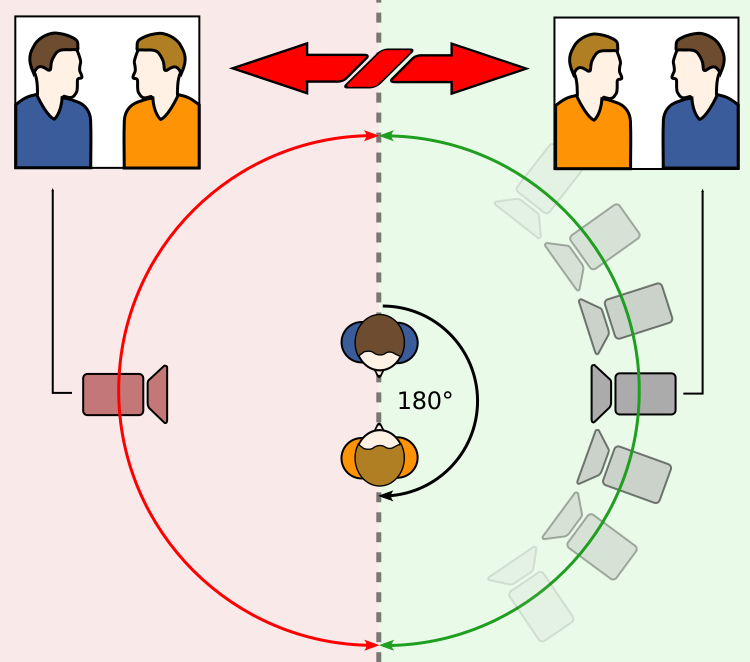
180 Degree Rule is described as below:

In a dialogue scene between two characters, Justin (orange shirt, frame left in the diagram) and Drew (blue shirt, frame right), the camera may be placed anywhere on the green 180° arc and the spatial relationship between the two characters will be consistent from shot to shot, even when one of the character is not on screen. Shifting to the other side of the characters on a cut, so that Drew is now on the left side and Justin is on the right, may disorient the audience.

File:180 degree rule.svg

However if the 180 degree rule is crossed, it will confuse the audience because the directions will be different. For example if we see a person on our left and then suddenly they change directions and we see them on our right, it will confuse us as we will be wondering if the person was on the right or the left.

Friday, 18 November 2011

Camera Angles and Movements

Camera Angles

Some of the angles will give the audience more information about the characters and their emotions ad feelings. I looked at some of the angles below. 


This is an eye level shot and it shows us that the character is equal as the audience watching the character.


This is a high angle shot and this is where the camera is above the character. This makes the character look small and in less power over others.


This is a low angle shot, where the camera is below the character and it helps to make the audience feel that the character has more power, is more important. 


Camera Movements


This is a Pan. It basically means that the camera  stand is still in one position and the person filming will just move the camera around or up and down. Can be used on a  spinning chair.


This is tracking. This movement of the camera is wen a person filming will move across the scene. Usually used when someone is driving or waking. Can be used when some on sits and other person pushes the to the side.


Scriptwriting

What is a script?
Script represents a text document containing a list of instructions that need to be executed by a certain program or scripting manager so that the desired automated action could be achieved. 

What makes an excellent script?

There is a scene heading
The name of the characters, then the dialogue
There is a good of description of action
There is a good of description of diagetic and non-diagetic sound
Good description of Shot- e.g. CUT TO...

Thursday, 17 November 2011

Audience

How much television do I watch a week?
I don't really watch that much television but I would say that I watch around 7 hours of television a week which makes it 1 hour a day.
Do I have cable, satellite or Freeview?
Cable
Do I have a television set in my bedroom?
Yes
What are my favourite television programmes?
Big Brother, X-Factor, The Fades, I'm a celebrity... and Top Boy
My answers build up a profile of a person as a media consumer.

A media product cannot exist without and audience. The products that the creative media create are all designed for a specific audience. Targeting the right product at the right audience in the right way is an important skill that all media producers must develop if their particular product is going to survive.


Definition Of Audience
The definition that i have found on the Internet is :The people who watch or listen to a television or radio program

Classification of audiences
Some target audiences are quite broad. Olympic Games, for instance, will target a mass market. Some products are targeted at a much narrower, specialised target audience and is often referred to as a niche market.
Audience can be divided into different categories.
The categories that I would put them into to are :
  • Age
  • Gender
  • Social Class
  • Culture
  • Lifestyle
  • Sexual orientation
  • Location

Media organisations undertake audience research to find out information about their target audience using primary, secondary, quantitative and qualitative research methods and techniques.
Media organisations use primary research techniques such as focus groups, questionnaires and face-to-face interviews. Secondary research can be obtained by using ratings and circulation figures from specialised media research organisations.
Audiences interact with and respond to different elements or codes, There are verbal codes (language); visual codes (what is seen) ; and aural codes (music).

Friday, 4 November 2011

Analysis of the intro of an action film 'Inception'

I found out that Inception has more than one genre so I decided to pick and analyse the Action genre. The Action genre is where one or more characters are thrust into a series of challenges. The shot types used in action genre are Mid-shot, close ups, low and high angle shot, establishing shot, long shot and over the shoulder shot. All of this shots are really important in an action genre because they help us to understand what is going on in the film and they help us to see different feelings of the characters. The intro of the Film gives us a clear understanding that it is action because it involves us in the scene straight away and the character is being faced different challenges such as waking up in the middle of no-where and being threatened with a gun.
Thank you for reading this analysis. Hope you liked it. Keep following :)